
El Japan Advanced Institute of Science and Technology (JAIST) es una universidad de posgrado situada en Nomi, Ishikawa, fundada en 1990
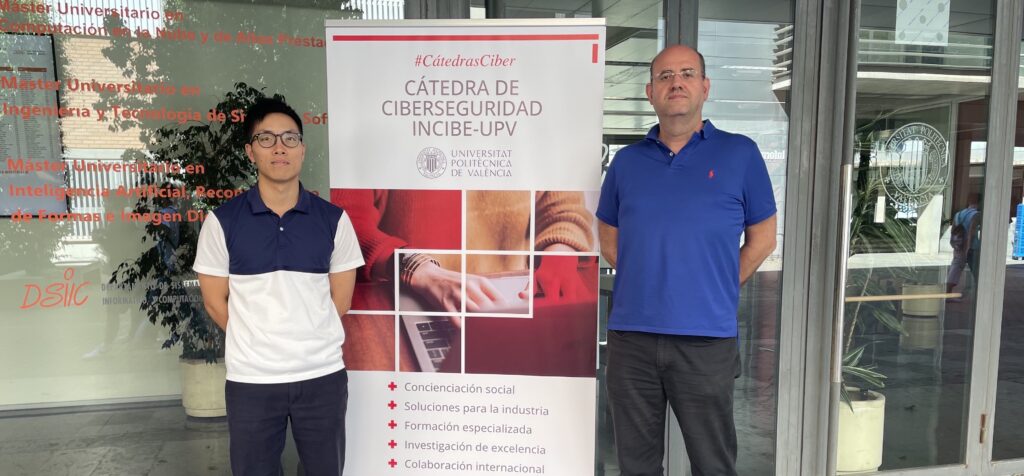
València, October , 17, 2024.- The young researcher of the JAIST (Japan Advanced Institute of Science and Technology (JAIST), Canh Min Do, is working on the research of post-quantum protocols together with the professor of the UPV and director of the Chair of Cybersecurity INCIBE-UPV, Santiago Escobar.
This chair is part of the agreement between the National Institute of Cybersecurity (INCIBE), an entity under the Ministry for Digital Transformation and Public Function, through the Secretary of State for Digitalisation and Artificial Intelligence, and the Universitat Politècnica de València, included in the programme of Chairs of Cybersecurity in Spain, within the framework of the Recovery, Transformation and Resilience Plan, with funding from the Next Generation-EU Funds.
Santiago Escobar, as an expert in post-quantum protocols, is supervising Canh Min Do’s research work during his stay at the Universitat Politècnica de València.
The fruitful relationship between researchers in the international arena is one of the objectives of the INCIBE-UPV Cybersecurity Chair.
The Japan Advanced Institute of Science and Technology (JAIST) is a graduate university located in Nomi, Ishikawa, founded in 1990. It has advanced research and development programmes in science and technology, as well as several campuses, courses and satellite conferences.
Cybersecurity Chairs Programme in Spain
INCIBE, within the Global Security Innovation Programme, has the particular mission of raising cybersecurity capabilities and resources in the academic, business and technological ecosystems, aimed at boosting the cybersecurity capabilities of society and the economy in general. The aim of this initiative is to have a programme that seeks to promote and generate knowledge and its transfer to the productive sector, especially by establishing synergies between the social and economic spheres of cybersecurity. With the aim of developing this purpose, the public invitation for collaboration in the promotion of cybersecurity chairs in Spain was launched on 1 December 2022.
The initiatives and actions of the Cybersecurity Chairs programme in Spain are included in the Global Security Innovation Programme, included in the Recovery, Transformation and Resilience Plan (PRTR) through Component 15. Investment 7 Cybersecurity: Strengthening the capacities of citizens, SMEs and professionals and boosting the sector. It acts especially in three of the six key aspects of the industry listed in milestone 245 of the PRTR: boosting the national cybersecurity industry for the emergence, growth and development of companies in this sector; developing high value-added solutions and services in the field of cybersecurity; and training and developing specialised talent in the field of cybersecurity.
About INCIBE
The National Institute of Cybersecurity is an entity dependent on the Ministry for Digital Transformation and Public Function, through the Secretary of State for Digitalisation and Artificial Intelligence, consolidated as a reference entity for the development of cybersecurity and digital confidence of citizens and companies. It is also a driving force for social transformation and an opportunity for innovation, fostering R&D&I and talent.
About UPV
The Universitat Politècnica de València (UPV) is, according to the Academic Ranking of World Universities (ARWU), known as the Shanghai ranking, the best technological university in Spain. More than 70% of UPV students are already working a year after completing their studies. And this is largely due to paid internships in companies. The UPV has more than a thousand agreements that allow student exchanges with other universities in Europe, Latin America, the United States, Canada, Australia, China and Japan. In its little more than 50 years of history, it has produced more than 145,000 scientific publications. It is a national leader in the number of patents and one of the Spanish academic institutions that obtains most income from its research activity.
El joven investigador del JAIST, Canh Min Do, trabaja en protocolos post-cuánticos junto a la Cátedra de Ciberseguridad INCIBE-UPV
El Japan Advanced Institute of Science and Technology (JAIST) es una universidad de posgrado situada en Nomi, Ishikawa, fundada en 1990
València, 17 de octubre de 2024.- El joven investigador del JAIST (Japan Advanced Institute of Science and Technology (JAIST), Canh Min Do, está trabajando en la investigación de protocolos post-cuánticos junto al catedrático de la UPV y director de la Cátedra de Ciberseguridad INCIBE-UPV, Santiago Escobar.
Esta cátedra es parte del convenio entre el Instituto Nacional de Ciberseguridad (INCIBE), entidad dependiente del Ministerio para la Transformación Digital y de la Función Pública, a través de la Secretaría de Estado de Digitalización e Inteligencia Artificial, y la Universitat Politècnica de València, incluida en el programa de Cátedras de Ciberseguridad en España, en el marco del Plan de Recuperación, Transformación y Resiliencia, con la financiación de los Fondos Next Generation-EU.
Santiago Escobar, como experto en protocolos post-cuánticos está supervisando los trabajos de investigación de Canh Min Do en su estancia en la Universitat Politècnica de València.
La fructífera relación de investigadores en el ámbito internacional es uno de los objetivos de la Cátedra de Ciberseguridad INCIBE-UPV.
El Japan Advanced Institute of Science and Technology (JAIST) es una universidad de posgrado situada en Nomi, Ishikawa, fundada en 1990. Cuenta con programas de investigación y desarrollo avanzados en ciencia y tecnología, así como varios campus, cursos y conferencias satélite.
Programa de Cátedras de Ciberseguridad en España
INCIBE, dentro del Programa Global de Innovación en Seguridad, tiene como misión particular la elevación de las capacidades y recursos en ciberseguridad, en los ecosistemas académico, empresarial y tecnológico, dirigidos a impulsar las capacidades en ciberseguridad de la sociedad y la economía en general. Esta iniciativa tiene el propósito de disponer de un programa que persiga la promoción y generación del conocimiento y la transferencia del mismo al sector productivo, especialmente estableciendo sinergias entre los ámbitos sociales y económicos de la ciberseguridad. Con el objetivo de desarrollar este propósito se lanzó el pasado 1 de diciembre de 2022 la invitación pública para la colaboración en la promoción de cátedras de ciberseguridad en España.
Las iniciativas y actuaciones del programa de Cátedras de Ciberseguridad en España se engloban dentro delPrograma Global de Innovación en Seguridad, contemplado en el Plan de Recuperación, Transformación y Resiliencia (PRTR) a través del Componente 15. Inversión 7 Ciberseguridad: Fortalecimiento de las capacidades de ciudadanos, PYMES y profesionales e impulso del sector. Actúa especialmente en tres de los seis aspectos claves de la industria recogidos en el hito 245 del PRTR: impulsar la industria nacional de la ciberseguridad para el surgimiento, crecimiento y desarrollo de empresas en este sector; desarrollar soluciones y servicios de alto valor añadido en el ámbito de la ciberseguridad; y formar y desarrollar talentos especializados en el ámbito de la ciberseguridad.
Sobre INCIBE
El Instituto Nacional de Ciberseguridad es una entidad dependiente del Ministerio para la Transformación Digital y de la Función Pública, a través de la Secretaría de Estado de Digitalización e Inteligencia Artificial, consolidado como entidad de referencia para el desarrollo de la ciberseguridad y de la confianza digital de los ciudadanos y las empresas. Además, es un motor de transformación social y oportunidad para la innovación, fomentando la I+D+i y el talento.
Sobre UPV
La Universitat Politècnica de València (UPV) es, según el Academic Ranking of World Universities (ARWU), conocido como ranking de Shanghai, la mejor universidad tecnológica de España. Más del 70% del alumnado de la UPV ya trabaja al año de haber finalizado sus estudios. Y ello se debe en buena medida a las prácticas en empresa que son remuneradas. La UPV mantiene más de mil convenios que permiten el intercambio de estudiantes con otras universidades europeas, de América Latina, Estados Unidos, Canadá, Australia, China y Japón. En sus poco más de 50 años de historia, ha producido más de 145.000 publicaciones científicas. Es líder nacional en número de patentes y una de las instituciones académicas españolas que más ingresos obtiene gracias a su actividad investigadora.